
As a temporary fence manufacturer supplying different export markets, one question we receive repeatedly is:
“What is the standard temporary fence panel size?”
The short answer is that there is no single global standard size.
In the U.S., suppliers commonly list 6 ft H × 10 ft W and 6 ft H × 12 ft W temporary fence panels.
In Canada, welded-mesh temporary fence fleets commonly use 6 ft H × 10 ft W and 6 ft H × 9.5 ft W panels.
In Australia, 2100 mm H × 2400 mm W is a common full-height temporary mesh fence format.
But from a manufacturing and procurement perspective, nominal panel size is only the first check.
Before we recommend a product configuration or prepare a production specification, we also need to understand the actual dimensions, frame tubing, welded mesh or chain-link specification, bases, clamps or couplers, braces or stays, compatibility with the existing rental-fleet system, packing requirements, and the requirements that apply to the final project.
The key point is simple:
Common market size ≠ universal legal requirement ≠ complete-system compliance.
This guide explains the common temporary fence panel sizes we see across the U.S., Canada and Australia, and the specifications buyers should confirm before placing an order.
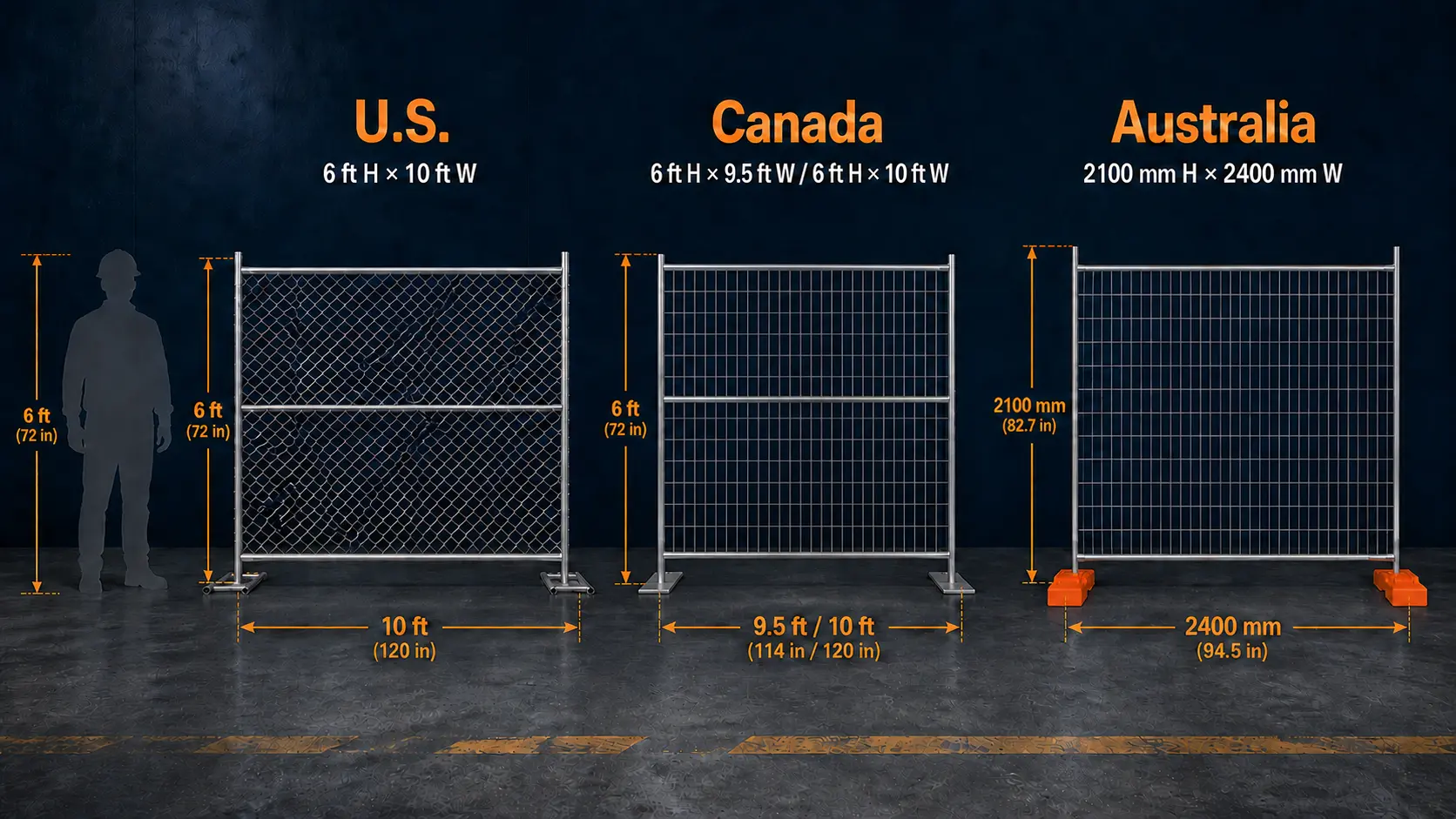
Temporary Fence Panel Size Chart: U.S., Canada and Australia
The table below is a practical comparison of commonly listed market sizes.
| Market | Common listed sizes | Common system style | What we recommend checking |
|---|---|---|---|
| U.S. | 6 ft H × 10 ft W; 6 ft H × 12 ft W; 8 ft H × 10 ft W | Round-tube chain-link panels are common; welded-mesh systems also exist | Actual frame size, base type, center support, clamps and local project requirements |
| Canada | 6 ft H × 10 ft W; 6 ft H × 9.5 ft W; 8 ft H × 10 ft W; some 4 ft H options | Welded-wire mesh with portable bases and top couplers is common | Actual width, base slot/rod, coupler fit and compatibility with the existing rental fleet |
| Australia | 2100 mm H × 2400 mm W; 2100 mm H × 1200 mm W half panel | Welded-mesh panel with temporary feet, clamps and stays | Foot opening, clamp, stay, wind/screen conditions and applicable project requirements |
These dimensions should be understood as common market specifications, not universal legal dimensions.
Based on the RFQs we handle, this distinction is very important.
Some buyers ask us for a “standard panel,” but what they actually need may be:
- a panel that matches an existing system;
- a panel that meets project requirements;
- or a panel suitable for sale or rental in the local market.
What Does “Standard Temporary Fence Panel Size” Really Mean?
When a buyer asks us for a standard temporary fence panel, we normally need to clarify one point first:
What does “standard” mean in this inquiry?
That question actually contains three different questions:
- What size is commonly sold in the target market?
- What does the local project or authority require?
- What dimensions and components are needed to match the buyer’s existing system?
These are not always the same.
Market Convention Is Not the Same as a Legal Requirement
A market convention is simply a size that suppliers, rental companies or contractors commonly use.
Legal or project requirements may address:
- minimum fence height;
- system construction;
- security performance;
- wind-load performance;
- or other jobsite conditions.
For example, the fact that 6 ft-high temporary panels are widely available in the U.S. does not mean every U.S. construction project accepts a 6 ft fence.
The same applies in Canada and Australia.
When a buyer is purchasing for a specific project, we recommend confirming the following before the order is finalized:
- the local authority having jurisdiction;
- bid documents;
- contract drawings;
- jobsite wind-load requirements;
- security requirements.
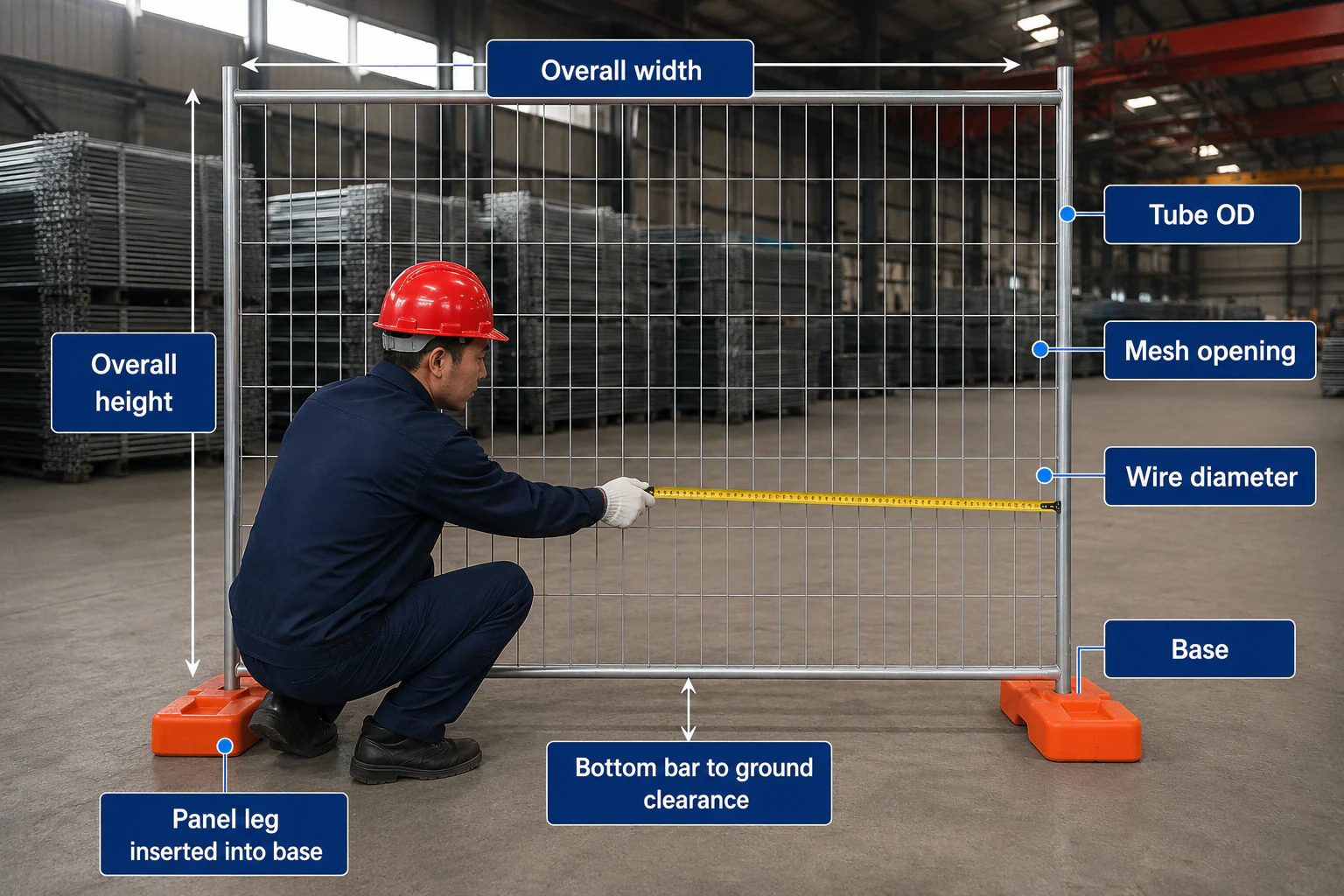
Nominal Size Is Not the Same as Actual Size
One of the most common problems we see at the inquiry stage is a buyer sending only:
“6 × 10 temporary fence panel.”
From a factory perspective, that is not enough information to confirm production or system compatibility.
We first need to confirm:
- Is it 6 ft high × 10 ft wide?
- Is the quoted size nominal or actual outside size?
- What is the frame tube diameter or side dimension?
- What is the panel leg size?
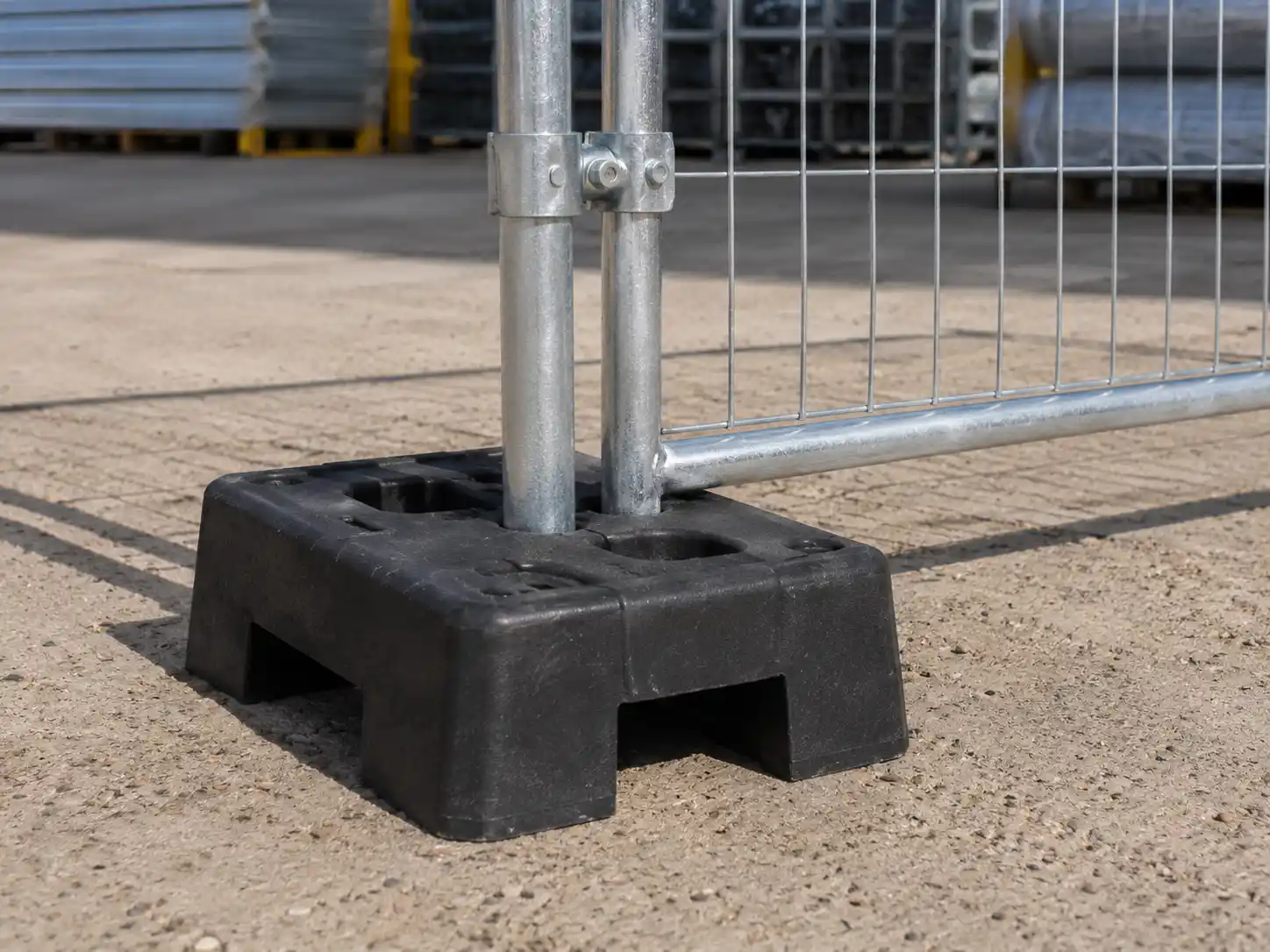
- What base will be used?
- What clamp or coupler needs to fit?
- Does the panel need to match an existing rental fleet?
Two panels can both be called 6 ft H × 10 ft W and still be incompatible.
They may differ in:
- overall outside dimensions;
- frame tube OD or side dimension;
- wall thickness;
- wire diameter;
- mesh opening;
- panel leg projection;
- base slot or pin dimensions;
- clamp geometry;
- manufacturing tolerance.
For replacement orders or rental-fleet expansion orders, we recommend matching the system using:
- drawings;
- physical samples;
- verified actual measurements.
These are more reliable than matching only by the nominal panel-size name.
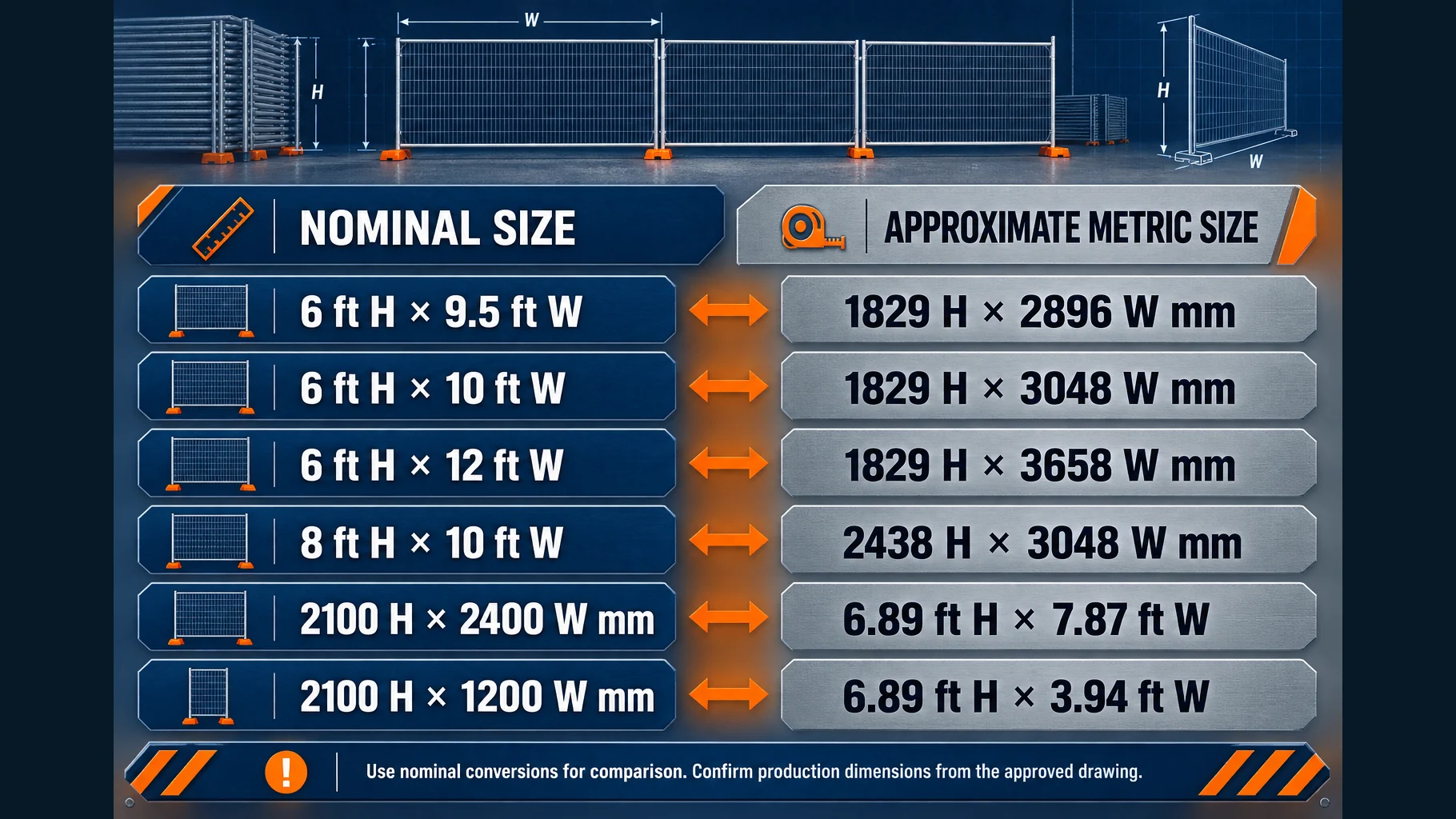
Temporary Fence Panel Imperial-to-Metric Conversion
Buyers comparing North American and Australian systems often need to move between imperial and metric units.
Here are several common nominal conversions:
| Nominal size | Explicit H × W | Approximate metric size | What we would still verify |
|---|---|---|---|
| 6 × 9.5 ft | 6 ft H × 9.5 ft W | 1829 H × 2896 W mm | Actual outside width and fleet fit |
| 6 × 10 ft | 6 ft H × 10 ft W | 1829 H × 3048 W mm | Drawing dimensions and accessories |
| 6 × 12 ft | 6 ft H × 12 ft W | 1829 H × 3658 W mm | Handling, frame specification and packing |
| 8 × 10 ft | 8 ft H × 10 ft W | 2438 H × 3048 W mm | Project height requirement |
| 2.1 × 2.4 m | 2100 H × 2400 W mm | About 6.89 ft H × 7.87 ft W | Direction, foot and clamp system |
| 2.1 × 1.2 m | 2100 H × 1200 W mm | About 6.89 ft H × 3.94 ft W | Intended layout and application |
Size conversions are useful for comparing markets.
However, we do not recommend using a converted nominal size directly as the final production specification.
The finished product should be based on the approved drawing.
Common Temporary Fence Panel Sizes in the U.S.
6 ft H × 10 ft W Temporary Fence Panels
A 6 ft H × 10 ft W panel is one of the commonly listed U.S. temporary fence formats.
Round-tube chain-link temporary fence panels are especially familiar in the U.S. market, although welded-mesh temporary fence systems are also available.
When we receive an inquiry for a U.S.-market 6 × 10 panel, panel size is only the starting point.
We normally also need to clarify items such as:
- round tube size;
- tube wall thickness or gauge;
- chain-link or welded mesh specification;
- center support;
- panel legs;
- base type;
- clamp;
- brace requirements;
- surface finish;
- packing method.
If the customer is adding new panels to an existing rental fleet, we also confirm:
- whether the panels must fit the existing bases;
- whether they must fit the existing clamps;
- whether they must fit the existing transport or storage racks.
6 ft H × 12 ft W Temporary Fence Panels
6 ft H × 12 ft W is another commonly listed U.S. panel size.
For the same straight fence run, a wider panel can reduce the number of joints.
For example:
300 ft ÷ 10 ft = 30 nominal panel widths
300 ft ÷ 12 ft = 25 nominal panel widths
However, we would not recommend choosing the 12 ft panel only because it uses fewer panels.
A wider frame can also affect:
- manual handling;
- storage rack dimensions;
- pallet or bundle dimensions;
- transport;
- frame deformation risk;
- complete-system stability.
The correct comparison is therefore not simply:
10 ft panel price vs. 12 ft panel price
It should be:
complete system + handling + packing + site requirements.
8 ft H × 10 ft W and Project-Specific Heights
8 ft H × 10 ft W temporary fence panels are also available in the U.S.
But we do not treat 6 ft or 8 ft as one nationwide legal height.
Different cities and projects can have different requirements.
Before a buyer confirms a project-specific height, we recommend checking:
- the authority having jurisdiction;
- contract drawings;
- security requirements;
- site conditions;
- wind or screening requirements.
What We Ask U.S. Buyers to Confirm
For a U.S.-market temporary fence inquiry, a useful specification sequence is:
Panel H × W → actual dimensions → frame tube → mesh/chain link → center support → panel legs → base → clamp → brace → screen/sign use → packing
If the system must match existing rental stock, we recommend including current measurements or a sample in the approval process.
Trade compliance note: U.S. importers should confirm the current scope, classification and applicable import requirements with their customs broker or trade counsel before ordering temporary steel fencing from China. Panel dimensions alone do not determine trade-remedy scope.
Common Temporary Fence Panel Sizes in Canada
6 ft H × 10 ft W Welded-Mesh Panels
A 6 ft H × 10 ft W welded-mesh temporary fence panel is a common Canadian format.
Canadian portable fence systems commonly use:
- removable steel bases;
- top couplers or connectors.
For rental companies, rental-fleet compatibility is therefore especially important.
When a Canadian rental company needs to add new panels to its existing fleet, we do not recommend matching only by nominal height and width.
We normally ask the buyer to confirm:
- actual panel height and width;
- square or round frame tube dimensions;
- panel leg dimensions;
- base slot or rod dimensions;
- top coupler dimensions;
- current surface finish;
- existing transport or storage requirements.
6 ft H × 9.5 ft W Temporary Fence Panels
Another Canadian market format is:
6 ft H × 9.5 ft W
or:
6 ft H × 9 ft 6 in W
A six-inch difference may not look significant on a specification sheet.
Across a complete rental fleet, however, it can affect:
- installed spacing;
- replacement planning;
- base positions;
- rack fit;
- bundle dimensions;
- overall layout.
When a customer needs new products to match an existing system, we prefer the buyer to provide:
- drawings;
- actual measurements;
- or a physical sample.
Our Approach to Existing-Fleet Matching
If a customer asks:
“Can your 6 × 10 panel fit the bases we already have?”
we cannot confirm that from the words “6 × 10” alone.
Where required, the matching process can include:
- confirming frame and panel-leg dimensions;
- checking the customer’s base slot or rod dimensions;
- checking coupler or clamp dimensions;
- producing or confirming a sample;
- performing a fit check before mass production.
The exact process depends on the order and the information available.
4 ft and 8 ft Height Options
Some Canadian rental fleets also use lower or higher panels, including approximately:
- 4 ft H × 10 ft W;
- 8 ft H × 10 ft W.
These should not be treated as one universal Canadian legal standard.
The final requirement may be affected by:
- the province;
- the municipality;
- project conditions;
- exposure to a public way;
- project specifications.
Common Temporary Fence Panel Sizes in Australia
2100 mm H × 2400 mm W Full-Height Panels
A common Australian full-height temporary mesh fence format is:
2100 mm H × 2400 mm W
Australian suppliers may also write this as:
2400 mm W × 2100 mm H
For international RFQs, we recommend clearly identifying both directions so there is no confusion between width and height.
A typical Australian-style temporary fencing system may include:
- welded-mesh framed panel;
- temporary fence foot;
- clamp;
- support stay or brace;
- other project-specific accessories.
When we review an Australian-market inquiry, we therefore look at the complete system rather than only the 2100 × 2400 mm panel size.
2100 mm H × 1200 mm W Half Panels
A 2100 mm H × 1200 mm W panel is commonly sold as a half panel.
Narrower panels can be useful for:
- corners;
- shorter sections;
- layout adjustment;
- filling remaining distance.
We do not automatically classify a half panel as a gate unless the product is specifically designed and supplied as a gate.
What AS 4687:2022 Does—and Does Not—Mean
Another question we receive is:
“If the panel is 2100 × 2400 mm, is it AS 4687 compliant?”
From a manufacturing perspective, we do not recommend answering that question from dimensions alone.
2100 mm H × 2400 mm W is a common Australian market format, but the size itself does not prove complete-system compliance with AS 4687:2022.
Where a buyer requires testing or compliance documentation, the correct review should identify:
- the applicable part and edition;
- the exact product/system tested;
- panel configuration;
- feet;
- clamps;
- stays;
- installation assumptions;
- test-report scope;
- any screening or attachments.
Any compliance statement should therefore correspond to:
- the actual report;
- the actual tested configuration.
The statement and the documented configuration must match.
We would not recommend using a generic statement such as:
“All 2100 × 2400 mm panels are AS 4687 compliant.”
That is not a sufficiently precise purchasing or technical conclusion.
View Australia Temporary Fence
The Market-Fit Panel Check We Recommend Before Ordering
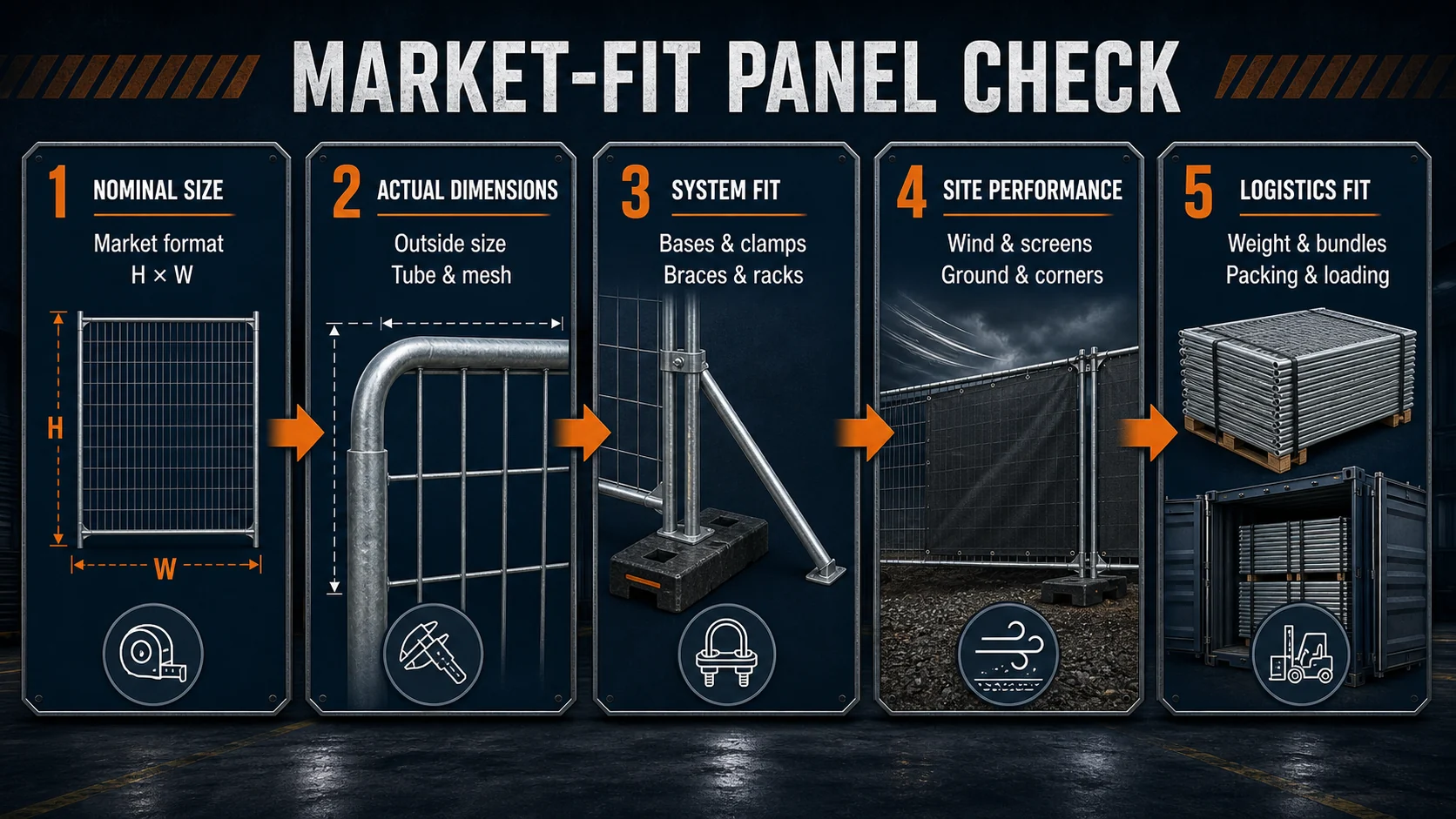
Based on the specification questions we regularly need to clarify before quotation or production, we use a simple five-part logic when evaluating temporary fence panels for different markets.
1. Nominal Size
What does the target market call the panel?
Examples:
- 6 ft H × 10 ft W
- 6 ft H × 9.5 ft W
- 6 ft H × 12 ft W
- 2100 mm H × 2400 mm W
Nominal size helps identify the market format.
It does not finish the specification.
2. Actual Dimensions
We then confirm the actual dimensions needed for production or system matching.
Depending on the project, this may include:
- finished outside height;
- finished outside width;
- frame tube;
- panel leg;
- mesh opening;
- wire diameter;
- relevant tolerances.
For fleet-matching orders, drawings or samples are especially useful.
3. System Fit
Next, we check whether the panel needs to match:
- feet or bases;
- clamps;
- couplers;
- braces or stays;
- storage racks.
This is where two panels with the same nominal size can produce very different results.
4. Site Performance
Panel dimensions alone cannot determine site performance.
The project may also need to consider:
- wind;
- screens;
- banners;
- corners;
- ground conditions;
- support stays;
- project engineering requirements.
5. Logistics Fit
Finally, the product has to fit the buyer’s logistics system.
Relevant checks may include:
- finished panel weight;
- pallet or rack dimensions;
- bundle layout;
- warehouse handling;
- container loading plan.
These figures should come from the actual quoted product specification, not from a generic number copied from another similar product.
How Panel Size Affects Cost, Handling and Logistics
Fewer Joints Do Not Automatically Mean Lower Cost
A wider panel normally reduces the number of panel joints over the same straight fence run.
But from a factory quotation perspective, panel count is only one part of total system cost.
The final cost can also depend on:
- frame specification;
- mesh specification;
- base system;
- clamp system;
- braces;
- packing;
- handling;
- project requirements.
For this reason, we recommend comparing complete systems rather than comparing only the unit price of one panel.
Finished Weight Should Be Measured for the Exact Specification
Panel width alone does not determine weight.
The following factors all affect finished weight:
- tube size;
- wall thickness;
- wire specification;
- mesh opening;
- finish.
If a buyer needs weight data to plan:
- manual handling;
- warehousing;
- freight.
We recommend using the actual measured or calculated weight for the confirmed specification.
We do not recommend copying weight data from a product that looks similar but has a different construction.
Packing and Container Planning Should Match the Real Product
The same principle applies to container loading.
Panel size affects:
- pallet dimensions;
- rack dimensions;
- bundle quantity;
- handling;
- container layout.
A meaningful packing plan should correspond to the actual quoted:
- panels;
- bases;
- accessories.
If the product specification and packing method have not been defined, the following statement is not reliable:
“One container holds X panels”
The loading quantity must be based on the actual product and packing method.
How Many Temporary Fence Panels Do You Need?
For an initial estimate, buyers can use:
Panel count = fence run ÷ nominal panel width, rounded up
Then adjust for:
- actual installed coverage;
- corners;
- openings;
- gates;
- overlap.
Example: 300 ft Using 10 ft Panels
300 ÷ 10 = 30 panels
Use this as the initial calculation, then adjust for the real layout.
Example: 300 ft Using 12 ft Panels
300 ÷ 12 = 25 panels
The lower panel count does not automatically mean a lower complete-system cost.
Example: 100 m Using 2.4 m Panels
100 ÷ 2.4 = 41.67
Round up to:
42 panels
Then adjust for the installed configuration.
We do not recommend using one universal formula to calculate:
- bases;
- clamps;
- braces.
Different systems share and configure these components differently.
What We Ask Buyers to Confirm Before Quoting a Temporary Fence Order
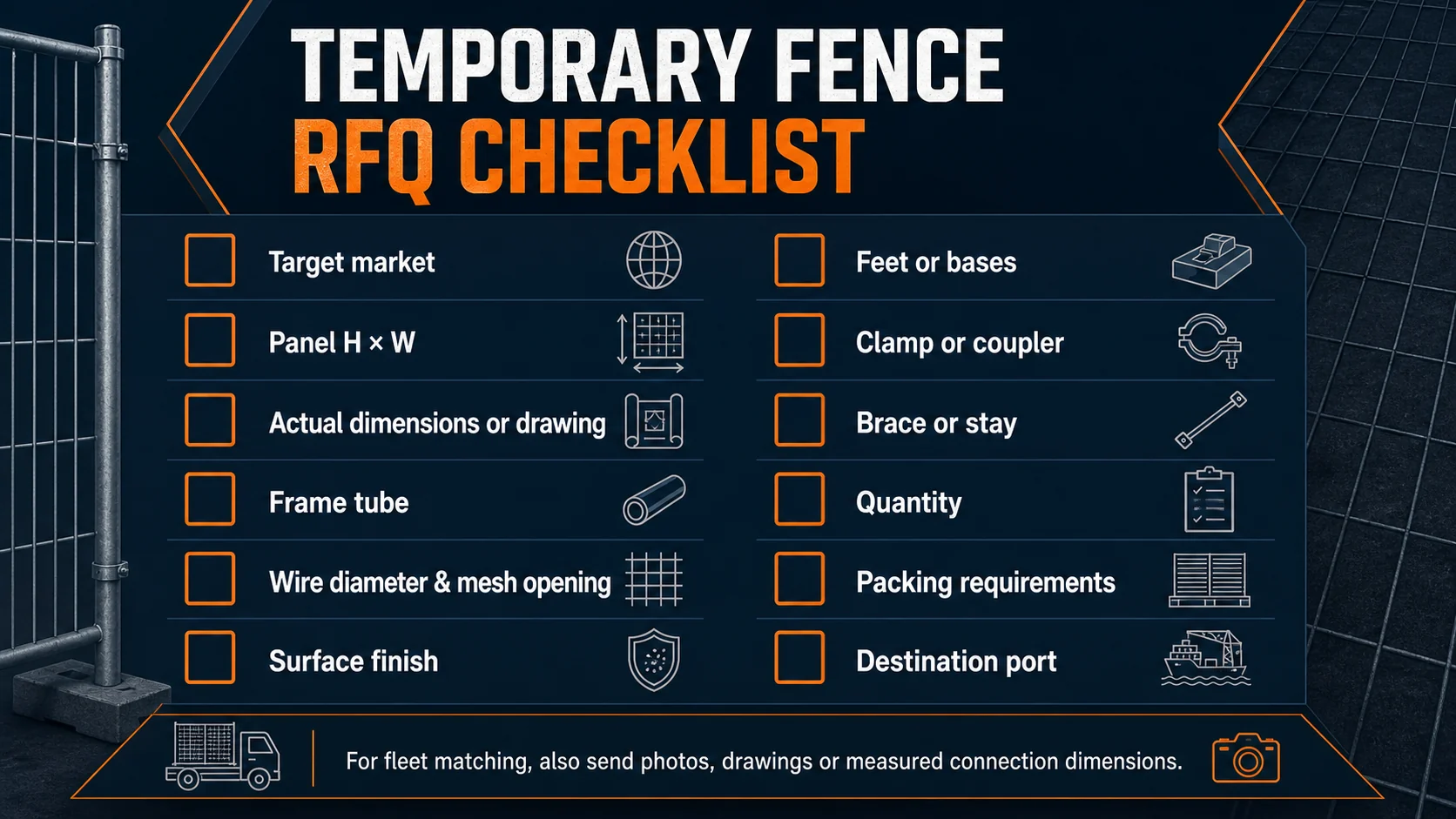
The fastest and most accurate RFQs we receive normally contain more information than just panel size.
A useful temporary fence RFQ should include:
| RFQ item | Example | Why we need it |
|---|---|---|
| Target market | U.S. / Canada / Australia | Helps identify market format and system expectations |
| Panel H × W | 6 ft H × 10 ft W | Prevents height/width confusion |
| Actual dimensions | Drawing/sample | Important for matching existing systems |
| Frame tube | OD/side × wall thickness | Affects structure and accessory fit |
| Wire/mesh | Diameter + mesh opening | Affects specification and weight |
| Finish | Pre-galvanized / HDG / coated | Ensures quotations use the same basis |
| Feet/bases | Type and dimensions | Determines panel support and compatibility |
| Clamp/coupler | Size/configuration | Determines connection fit |
| Brace/stay | Required configuration | Affects the complete system |
| Quantity | Panels or total fence run | Required for production planning |
| Packing | Pallet/rack/labels | Affects handling and shipment |
| Destination port | Country + port | Needed for logistics planning |
| Evidence required | Drawing/test/fit check/photos | Defines the approval process |
If a buyer only sends:
“Quote 6 × 10 fence.”
our first job is usually to clarify the specification before comparing price.
A more complete RFQ makes supplier quotations easier to compare and reduces the risk of receiving panels that do not match the intended system.
How We Can Check Temporary Fence Panels Before Packing
Before an order is packed, dimensional and compatibility checks should be based on the confirmed product specification, not only on the product name.
Depending on the order requirements, our factory inspection can include the following items.
Overall Dimensions
We can compare the finished panel with the approved drawing or confirmed specification, including relevant measurements such as:
- overall height;
- overall width;
- diagonal dimension.
Frame and Mesh Specification
Where required by the inspection plan, the check can include:
- frame tube dimensions;
- wire specification;
- mesh opening;
- agreed measurement method.
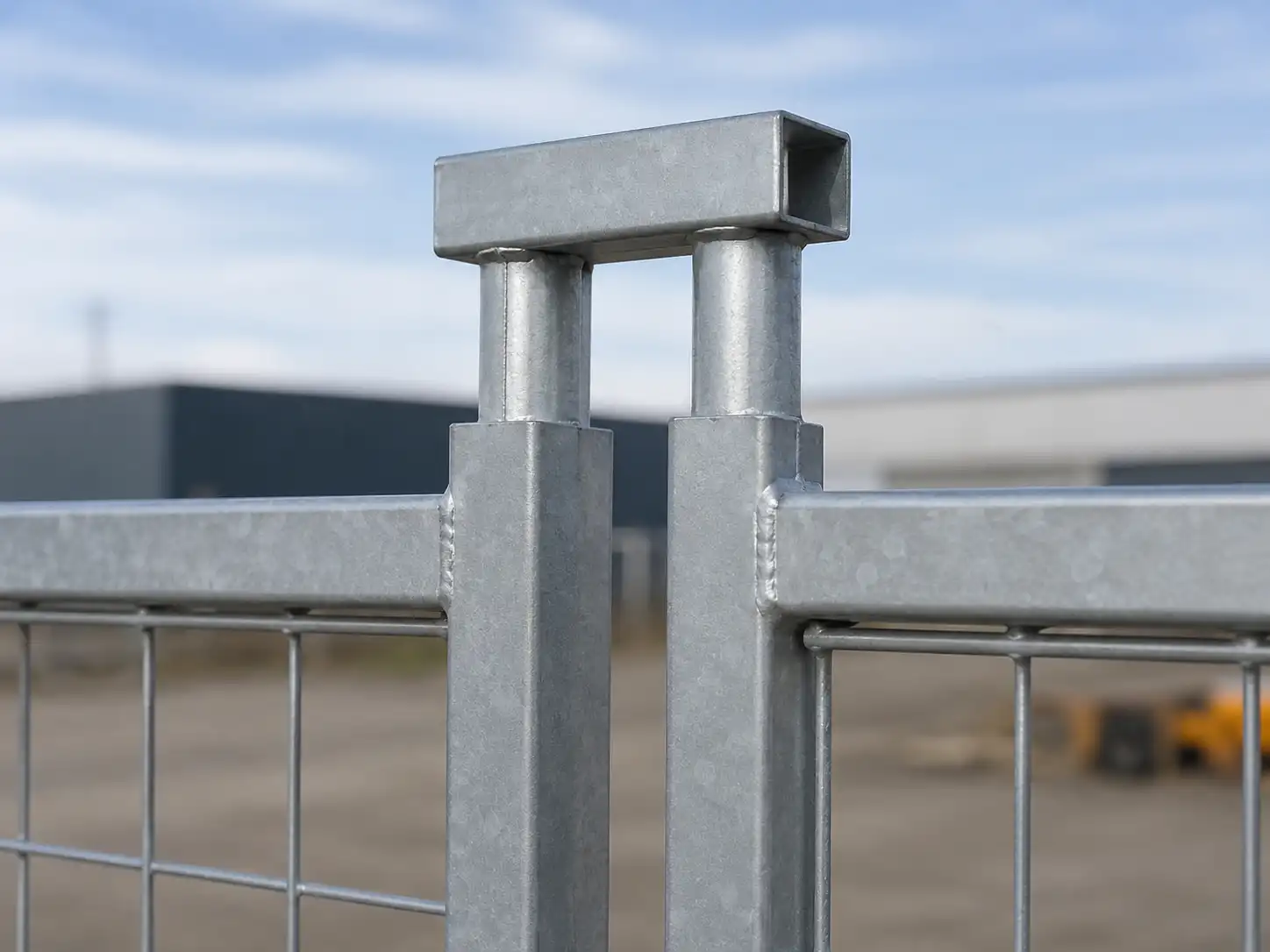
Base and Clamp Fit
For orders that need to match an existing system, a fit check can verify the connection fit for the:
- base;
- foot;
- clamp;
- coupler.
The purpose is to verify that the required connections fit correctly.
This is particularly useful when a rental company is adding imported panels to an existing fleet.
Surface and Visual Inspection
The finished product can also be checked against the confirmed order requirement for:
- surface finish;
- visible condition;
- basic workmanship.
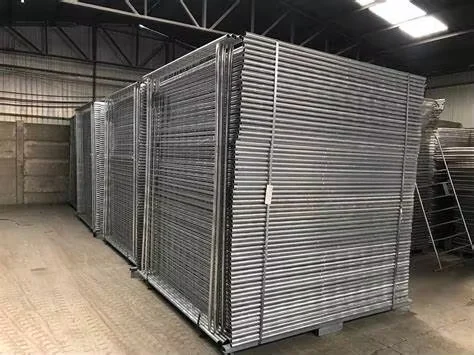
Packing Identification
Before shipment, packing checks may include:
- pallet or rack arrangement;
- labels;
- product identification;
- quantity identification.
For a rental-fleet matching project, we recommend providing the following before mass production whenever possible:
- existing base and clamp dimensions;
- the approved drawing;
- or a physical sample.
See Our Production and Shipping Process
Temporary Fence Panel Size FAQs
What Is the Standard Size of a Temporary Fence Panel?
There is no single global standard temporary fence panel size.
Common examples include:
U.S.:
- 6 ft H × 10 ft W;
- 6 ft H × 12 ft W.
Canada:
- 6 ft H × 10 ft W;
- 6 ft H × 9.5 ft W.
Australia:
- 2100 mm H × 2400 mm W.
The final specification should still be confirmed against:
- project requirements;
- the complete system.
Both should be confirmed before ordering.
Are Two 6 ft × 10 ft Temporary Fence Panels Always Interchangeable?
No.
Even if both are described as 6 ft H × 10 ft W, they can differ in:
- actual outside dimensions;
- frame tubing;
- panel legs;
- bases;
- clamps.
We recommend checking the relevant connection dimensions before confirming compatibility.
What Size Are Temporary Fence Panels in Canada?
Common Canadian market examples include:
- 6 ft H × 10 ft W
- 6 ft H × 9.5 ft W
Other heights are also available in some rental fleets.
What Is a Common Australian Temporary Fence Panel Size?
A common full-height format is:
2100 mm H × 2400 mm W
The market also offers:
2100 mm H × 1200 mm W
as a half panel.
Does a 2100 × 2400 mm Panel Automatically Comply With AS 4687:2022?
No.
Panel dimensions alone do not prove complete-system compliance.
The following must also be verified:
- the exact system;
- the applicable part of the standard;
- the test scope;
- the installation method;
- the accessory configuration.
How Many 10 ft Panels Are Needed for 300 ft?
300 ÷ 10 = 30 panels as an initial calculation.
This can be used as the initial quantity.
Then adjust for:
- gates;
- openings;
- corners;
- actual installed coverage.
Adjust the final quantity to the actual layout.
Can TOPSFENCE Match Panels to My Existing Bases and Clamps?
Compatibility should be confirmed using:
- dimensions;
- drawings;
- physical samples;
- a fit check.
If matching an existing rental fleet is required, send us the relevant panel, base and clamp dimensions before production.
What Information Should I Send for a Temporary Fence Quotation?
At minimum, send:
- target market;
- panel H × W;
- quantity;
- frame and mesh specification;
- finish;
- base/foot requirements;
- clamp/coupler requirements;
- destination port.
If the new system must match existing stock, also send:
- photos;
- drawings;
- measured connection dimensions.
Need a Temporary Fence Panel Matched to Your Market?
If you are importing temporary fence panels or expanding an existing rental fleet, send us more than just a nominal size.
For a more useful specification review, provide:
Target market · Panel H × W · Quantity · Frame/mesh requirement · Existing base or clamp dimensions · Destination port
Our team can review the requested configuration before preparing the quotation and production specification.
You can also view: