
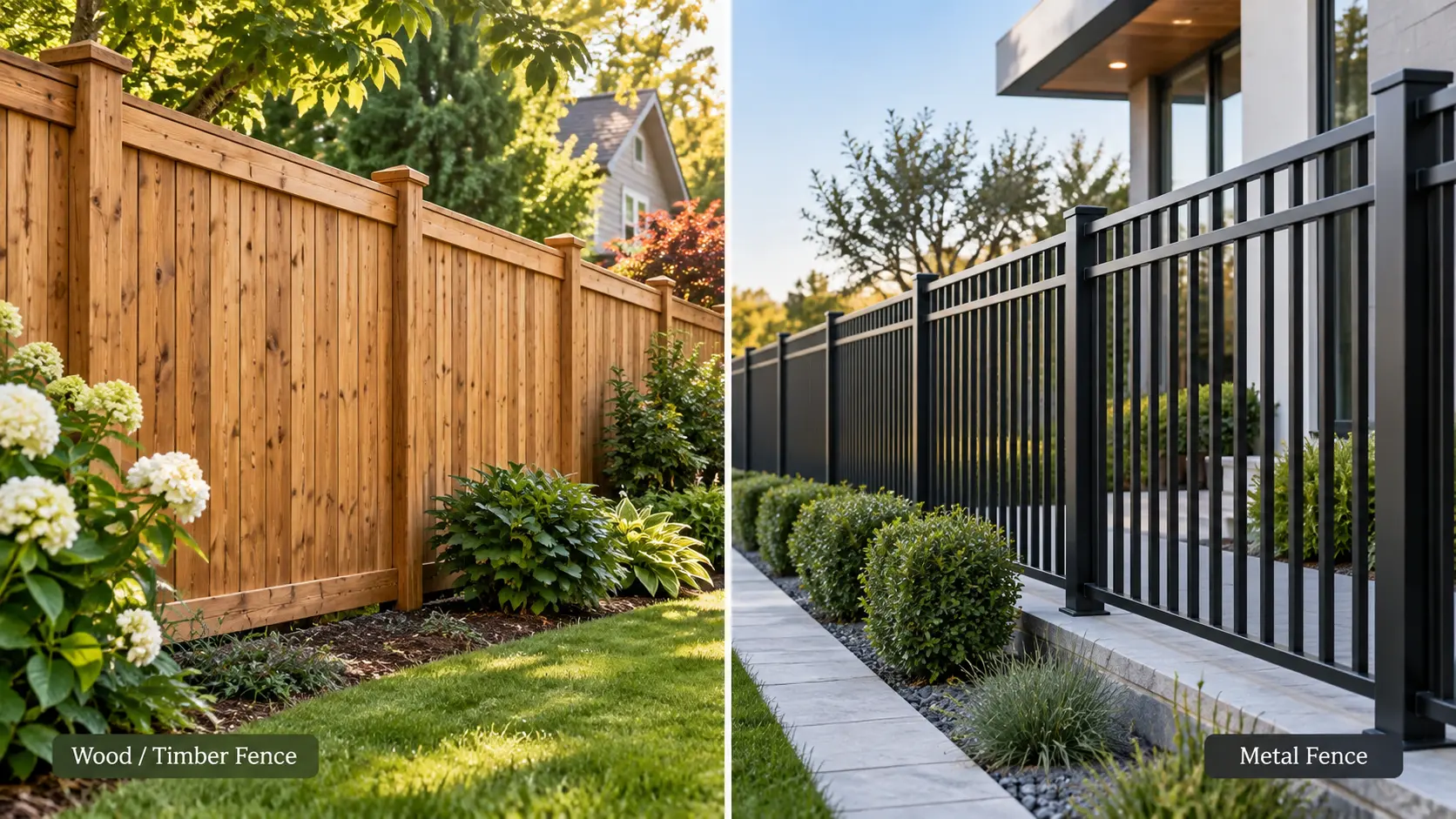
Choosing between a wood fence and a metal fence is not simply a question of which material is better.
Wood — commonly referred to as timber fencing in Australia — is often selected for privacy, a natural appearance and flexibility during on-site installation. Metal fencing is more commonly chosen when a project requires lower routine maintenance, repeatable panel specifications, matching gates or a wider range of steel and aluminium systems.
The right choice depends on the project rather than the material name alone. Cost, maintenance, exposure conditions, privacy, security, appearance and fabrication requirements all influence the final decision.
In this guide, wood fence, wooden fence and timber fence refer to the same broad material category.
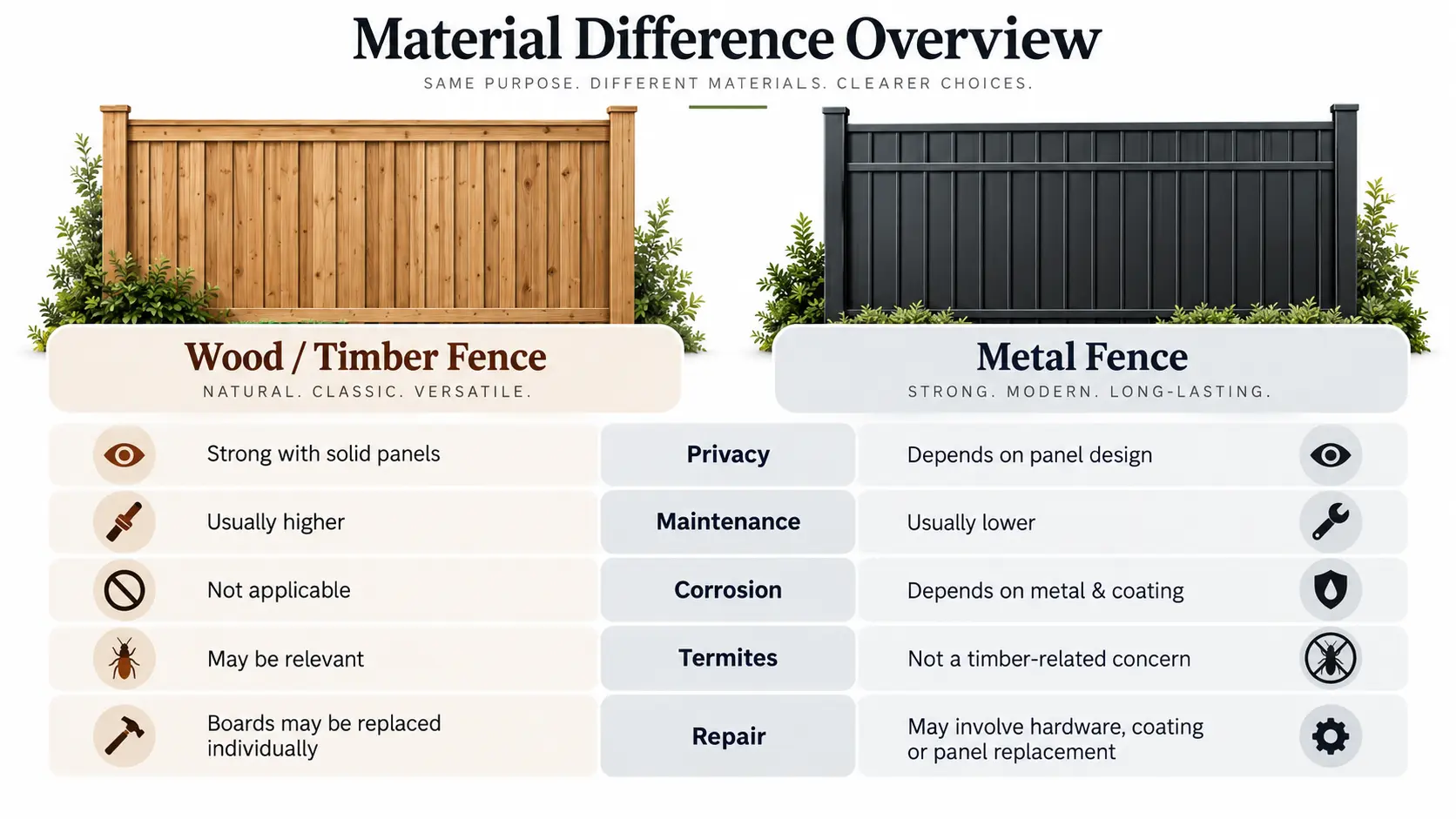
Wood Fence vs Metal Fence at a Glance
| Factor | Wood / Timber Fence | Metal Fence |
|---|---|---|
| Appearance | Natural and traditional | Modern, architectural or security-oriented |
| Privacy | Strong with solid paling or board systems | Depends on panel design |
| Routine maintenance | Usually higher | Usually lower |
| Rot and termites | May be relevant | Not timber-related concerns |
| Corrosion | Not applicable | Depends on metal, coating and exposure |
| Site adjustment | Usually easier to cut and modify | More dimensions should be confirmed before fabrication |
| Consistency | Natural material variation | Repeatable manufactured specifications |
| Security | Depends on structure and gate design | Wide range of light to heavier-duty systems |
| Coastal exposure | Timber species and treatment matter | Metal type and corrosion protection matter |
| Repair | Individual boards may be replaceable | May involve hardware, coating or panel replacement |
There is no universal winner.
A timber paling fence may be more practical where full visual privacy is the priority. A fabricated steel or aluminium fence may make more sense where consistent panels, coordinated gates and clearly defined specifications are required.
What Is a Wood, Wooden or Timber Fence?
A wood fence is built primarily from timber boards, palings, pickets, rails and posts.
In Australia, timber fence and timber fencing are common terms, while wood fence and wooden fence are frequently used in broader search language.
- Timber paling fences for boundary privacy
- Timber picket fences for more decorative applications
- Timber slat fences for contemporary screening
Performance depends on more than the fact that the fence is made from timber.
Timber species, preservative treatment, board dimensions, post spacing, drainage, installation quality and ongoing maintenance all influence service life.
For this reason, timber fencing should be compared as a complete system rather than as a single material category.
What Is a Metal Fence?
Metal fencing is also a broad category rather than one specific product.
For many residential, commercial and project applications, the two main material groups are steel and aluminium.
Steel Fencing
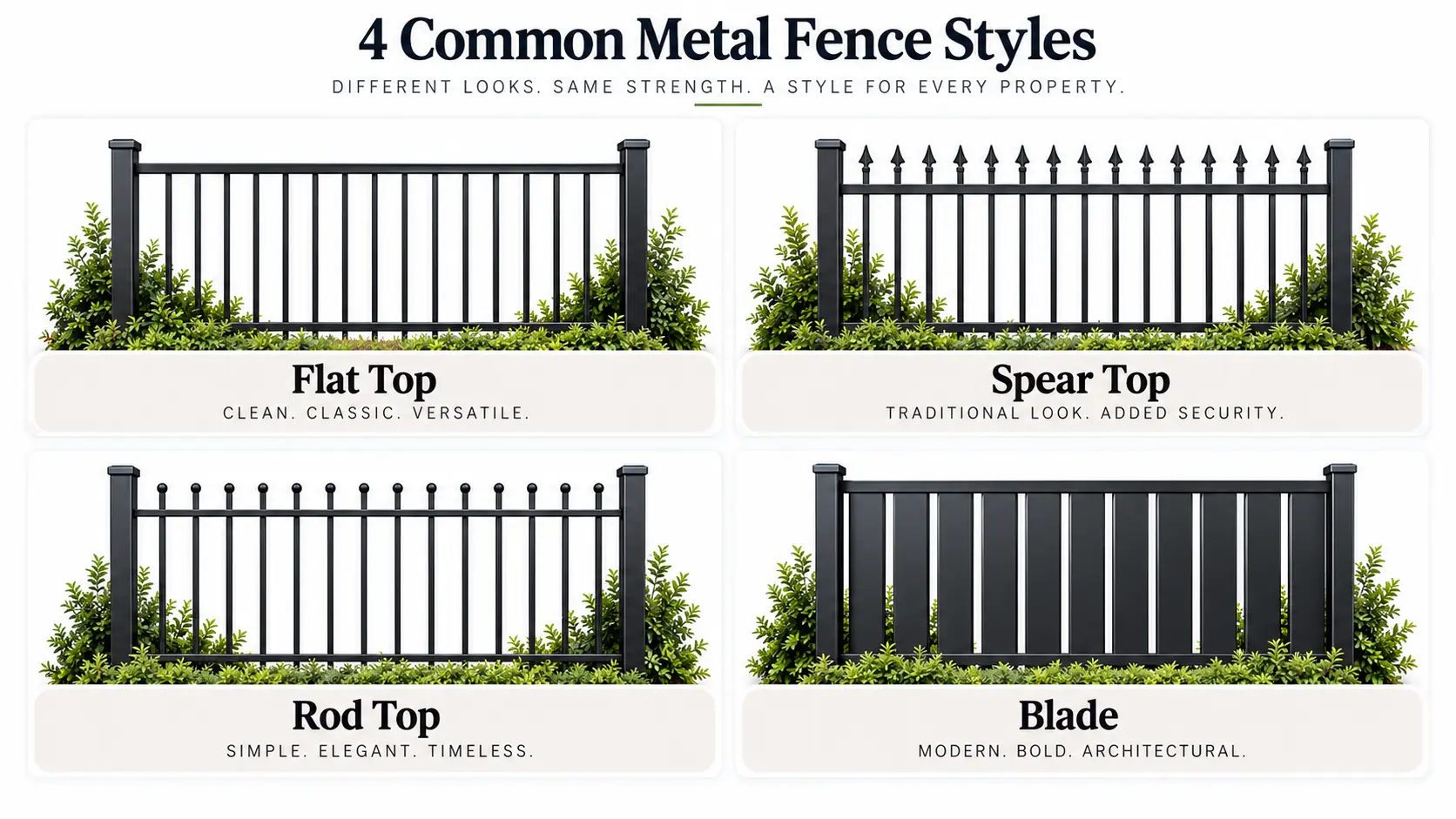
Steel fencing can be fabricated into a wide range of panel systems, including:
- Flat top fencing
- Spear top fencing
- Rod top fencing
- Blade fencing
- Security and perimeter fencing
Steel systems may use galvanizing, powder coating or a combination of protective treatments depending on the application and required exposure performance.
Steel is often selected where stiffness, stronger sections, repeatable panel construction or heavier-duty perimeter requirements are important.
Aluminium Fencing
Aluminium fencing is lighter than steel and behaves differently in corrosive environments.
It is commonly used for:
- Pool fencing
- Garden fencing
- Privacy fencing
- Architectural fence systems
- Decorative perimeter fencing
Aluminium does not develop the red rust associated with carbon steel, but alloy, finish, fasteners and environmental exposure still need to be considered.
Metal describes the material family. Flat top, spear top, rod top and blade describe fence styles.
Material and style should therefore be selected separately.
Wood Fence vs Metal Fence Cost
Cost is one of the main reasons buyers compare wood and metal fencing, but a single “price per metre” rarely gives the full picture.
Upfront Cost
Timber fencing cost can vary with:
- Timber species
- Board or paling dimensions
- Fence height
- Posts and rails
- Treatment
- Paint or stain
- Labour
A basic timber paling fence and a premium architectural timber screen should not be treated as equivalent products.
Metal fence cost can vary with:
- Steel or aluminium
- Panel dimensions
- Profile or picket size
- Wall thickness
- Post size
- Gate construction
- Galvanizing
- Powder coating
- Fixing method
Two black metal fences can look similar in photographs while having very different material weights and specifications.
Lifetime Cost
Total fence cost = initial material + installation + maintenance + repairs + eventual replacement
Timber may have a lower initial cost in some applications, but finishing, repairs and ongoing maintenance can add to total cost over time.
Metal fencing often reduces routine maintenance, although coatings, gates, hardware and damaged areas still require inspection.
For distributors and project buyers, packing, freight and installation time may also form part of the real project cost.
Which Lasts Longer: Wood or Metal Fencing?
Fence lifespan depends heavily on specification, installation and environment.
Timber may be affected by:
- Moisture
- Rot
- Termites
- Splitting
- Warping
- Weathering
The actual risk varies with timber species, treatment and site conditions.
Metal has a different set of durability considerations.
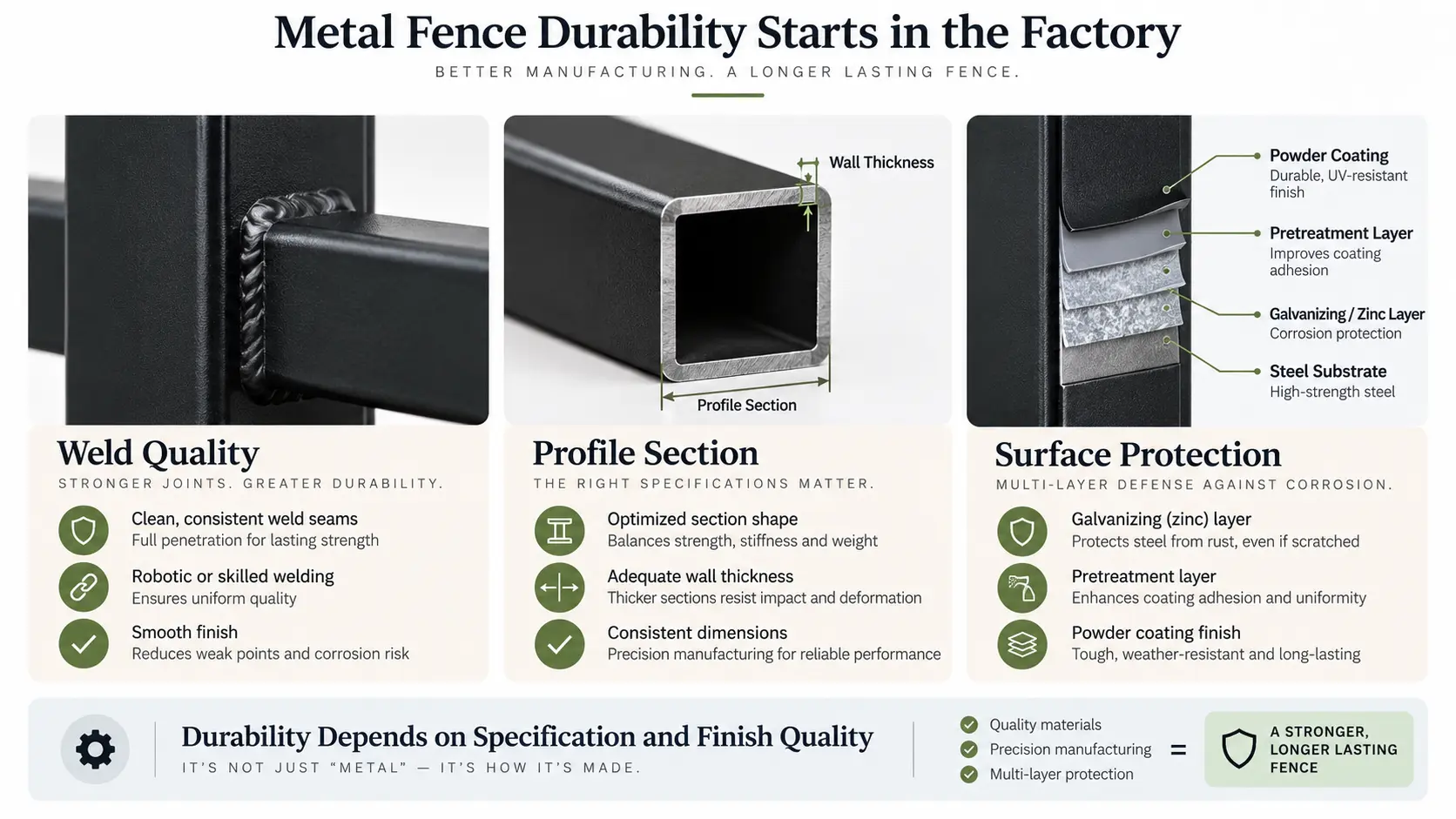
Steel can corrode if the protection system is unsuitable for the environment or if damaged areas remain untreated. Long-term performance can be influenced by:
- Galvanizing
- Surface preparation
- Powder coating
- Weld treatment
- Cut edges
- Drainage
- Connections
- Fasteners
Aluminium avoids the red-rust mechanism associated with carbon steel, but unsuitable materials, fasteners or exposure conditions can still affect long-term performance.
From a manufacturing perspective, visually similar metal fence panels are not necessarily equivalent.
Section thickness, weld quality, pretreatment, coating system and connection details can all affect how the finished fence performs.
Which complete fence specification is appropriate for the site and exposure conditions?
Which Requires More Maintenance?
Metal fencing generally requires less routine maintenance than timber fencing, but low maintenance does not mean maintenance-free.
Timber may require:
- Painting
- Staining
- Sealing
- Board replacement
- Inspection for rot
- Inspection for pest damage
Metal fencing may require:
- Cleaning
- Inspection of coatings
- Repair of scratches or damaged finishes
- Checking fasteners
- Checking weld areas
- Gate alignment and hardware maintenance
The maintenance profile is different rather than nonexistent.
Timber maintenance tends to focus on the material and surface finish. Metal fence maintenance tends to focus more on coatings, connections and moving components.
Wood vs Metal Fence for Privacy
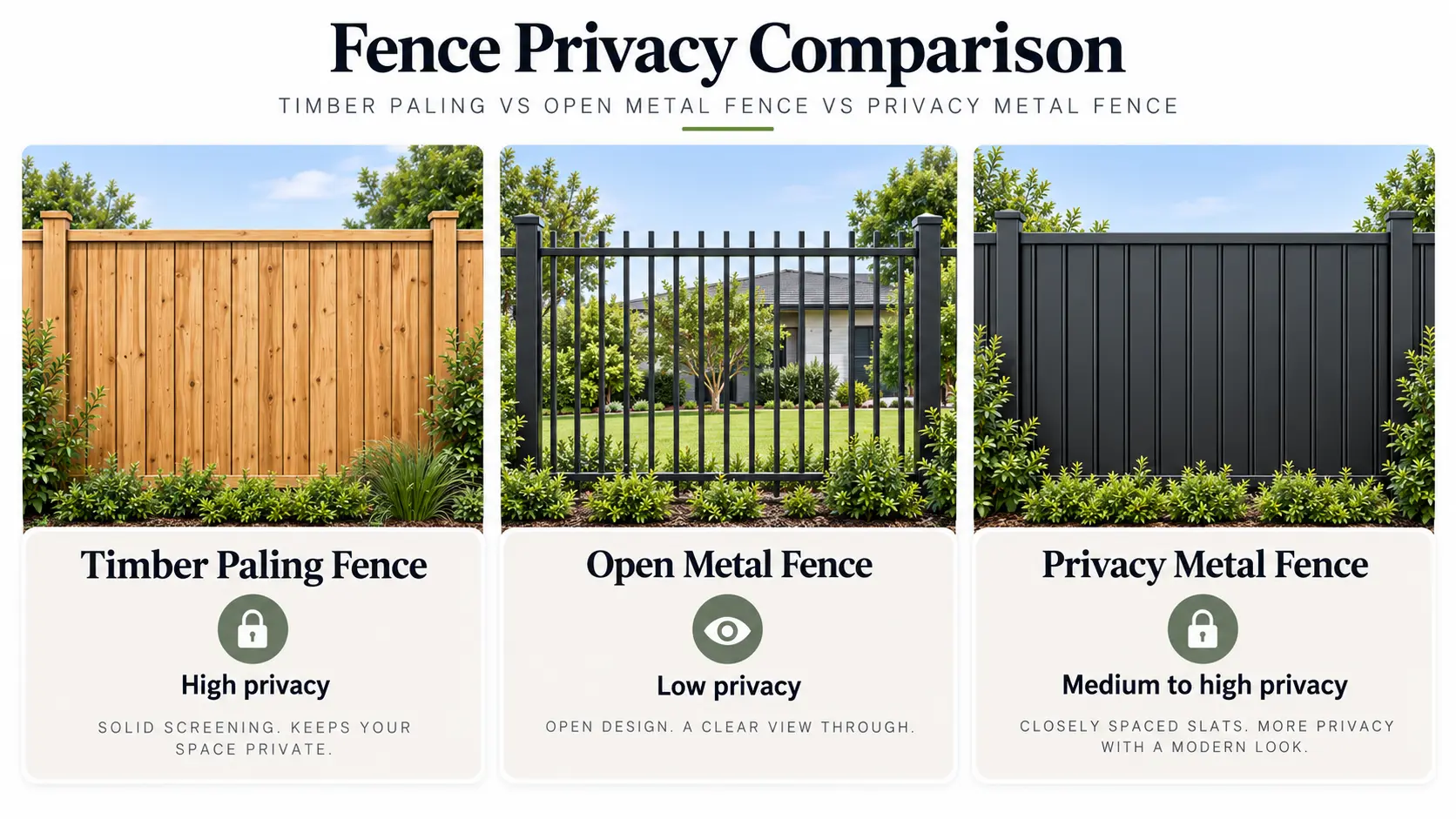
For full visual privacy, timber has a clear advantage in many traditional residential applications.
A timber paling fence can form a largely solid screen with limited direct visibility through the boundary.
Many metal fence systems are intentionally open.
Flat top fencing, spear top and rod top fencing, for example, are generally designed to provide boundary definition while maintaining airflow and visibility.
They should not be presented as full-privacy fencing when the design contains substantial open gaps.
However, metal fencing can also be designed for privacy. Options may include aluminium privacy panels, slat systems, solid metal panels and close-spaced blade systems.
The privacy requirement should therefore be defined before the material and panel style are selected.
Wood vs Metal Fence for Security
Security depends on the complete fence system rather than the base material alone.
Important factors include:
- Fence height
- Post strength
- Panel construction
- Profile spacing
- Fixing method
- Gate frame construction
- Hinges
- Locks
- Anti-climb detailing
A well-designed timber fence can provide an effective residential boundary.
Steel fencing, however, can be specified across a wider range of applications, from decorative perimeter fencing through to heavier commercial and security configurations.
For security projects, the actual panel, post and gate specification matters more than whether the fence is simply described as wood or metal.
Wood vs Metal Fencing in Australian Conditions
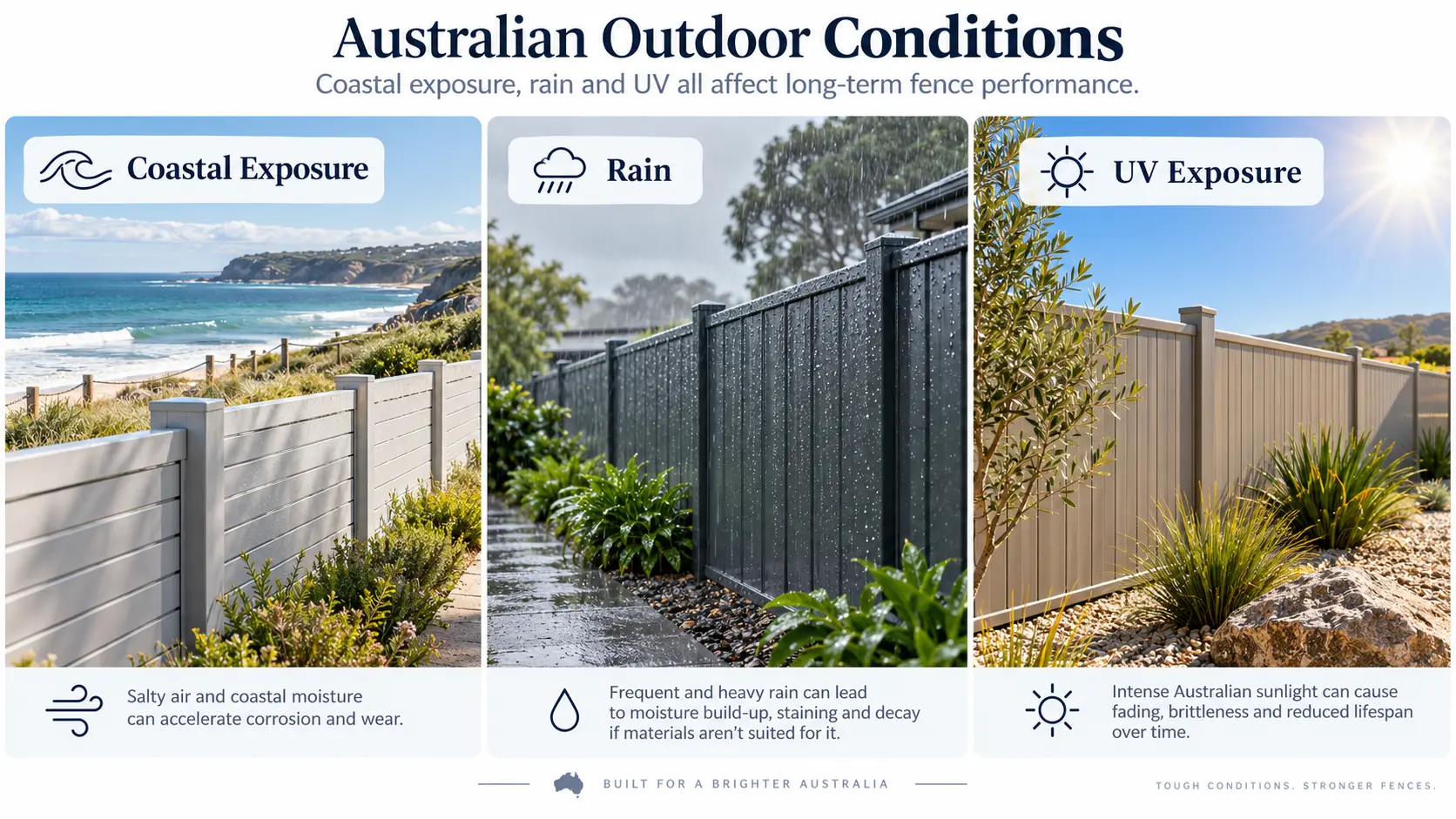
Australian projects may expose fencing to very different combinations of:
- UV
- Rain
- Humidity
- Termites
- Coastal salt
- Temperature variation
For timber, species selection, treatment and moisture management can influence performance.
For steel, the corrosion-protection system should be assessed rather than assuming every black powder-coated fence provides the same level of protection.
Aluminium is often considered for coastal applications because it does not rust in the same way as steel.
However, alloy, finish, fasteners and maintenance still need to match the environment.
The material name alone is not enough to define suitability.
Steel vs Timber Fencing: A Quick Comparison
The comparison of steel vs timber fencing deserves separate consideration because steel is only one part of the broader metal fencing category.
Timber may be more suitable where the project prioritises:
- Natural appearance
- Solid privacy
- Easy site cutting
- Traditional residential styling
- Individual-board repairs
Steel may be more suitable where the project requires:
- Repeatable factory-made panels
- Matching fabricated gates
- Defined post centres
- Custom profile dimensions
- Heavier-duty perimeter options
- Documented coating requirements
Neither material should be selected by appearance alone.
Sections, posts, connections, finish and installation conditions should all be compared.
When Is a Timber Fence the Better Choice?
Timber can be a strong choice when the design objective is a natural or traditional appearance.
It may also make sense where:
- Solid visual privacy is important
- Extensive on-site cutting is expected
- Irregular boundaries require frequent adjustment
- Individual-board replacement is preferred
- The project accepts ongoing timber maintenance
In these situations, timber's flexibility can be a real advantage.
When Is a Metal Fence the Better Choice?
Metal fencing can be more suitable where the project requires:
- Consistent manufactured panel dimensions
- Coordinated gates and posts
- Defined coating specifications
- Lower routine maintenance
- Repeatable production
- Project drawings or schedules
- Larger distributor or contractor quantities
Once a project has moved toward metal fencing, the next decision is usually whether steel or aluminium better suits the application.
After that, the fence style can be selected: flat top, spear top, rod top, blade, privacy or another project-specific design.
Already considering metal? Compare TOPSFENCE steel fencing and aluminium fencing systems.
What Project Buyers Should Compare Beyond Wood vs Metal
For project buyers, material selection is only the first step.
Quotations should be compared on a like-for-like basis.
A lower price may simply reflect lighter sections, fewer accessories or a different coating system.
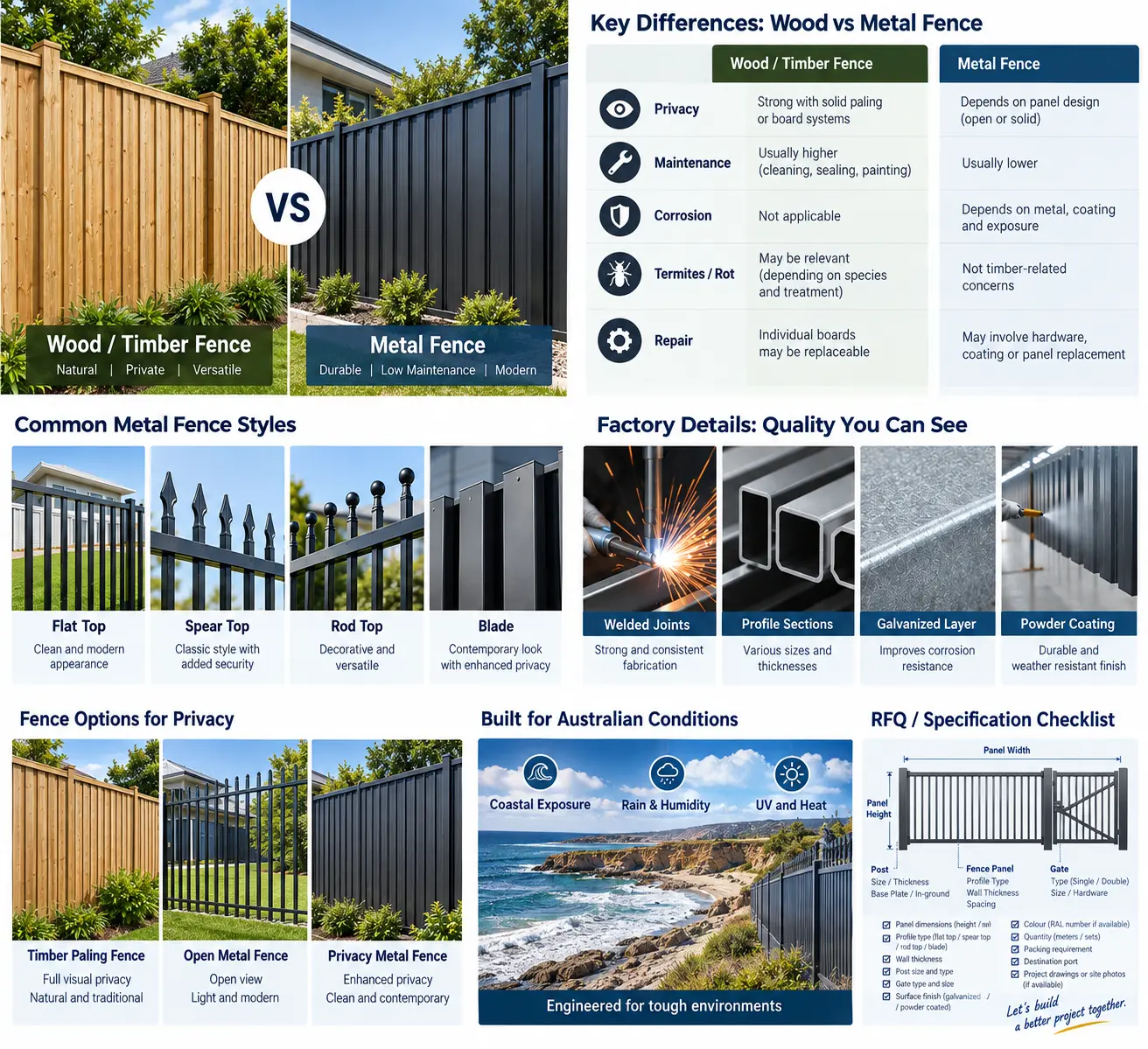
| Quote Input | What to Confirm |
|---|---|
| Fence system | Application and preferred style |
| Panels | Height, width and quantity |
| Profiles | Picket/profile size, spacing and wall thickness where applicable |
| Posts | Section, centres and fixing method |
| Gates | Quantity, opening size and frame type |
| Material | Steel or aluminium |
| Finish | Galvanizing, powder coating or other treatment |
| Accessories | Brackets, hinges, locks and fixings |
| Packing | Packing method and labelling requirements |
| Logistics | Quantity, destination port and target delivery timing |
This is also where manufacturer experience becomes useful.
At TOPSFENCE, project quotation review is based on the actual fence configuration rather than only a generic panel price. Panel dimensions, gate openings, post arrangement, finish, quantity and destination all affect the final supply scope.
Frequently Asked Questions
Is a metal fence cheaper than wood?
Sometimes, but not always. Initial cost depends on the timber species, metal type, fence design, height, posts, gates, finish and installation. A useful comparison should consider both upfront cost and long-term maintenance.
Are metal fences more expensive than wood?
Some fabricated steel or aluminium systems may cost more upfront than basic timber fencing. However, premium timber can also be expensive. Equivalent height, privacy, gate scope, finish and installation should be compared before drawing a conclusion.
Which lasts longer, a wood or metal fence?
There is no fixed answer without knowing the specification and environment. Timber depends on species, treatment, moisture conditions and maintenance. Metal depends on material, coating, detailing and exposure.
Does metal fencing require less maintenance than timber?
In many cases, yes. Timber often requires more regular surface maintenance, while metal generally requires less routine work. Metal fences should still be checked for coating damage, loose fixings and gate wear.
Is timber fencing the same as wooden fencing?
In normal buying and search language, yes. Timber fence, wood fence and wooden fence describe the same broad material category. “Timber fencing” is particularly common wording in Australia.
Is steel fencing better than timber fencing?
It depends on the project. Steel is often better suited to manufactured panel systems, matching gates and heavier perimeter applications. Timber may be more suitable for natural appearance, solid privacy and extensive on-site adjustment. The final choice should be based on project requirements rather than material preference alone.
Final Takeaway
Wood and metal fencing solve different problems.
Timber is often the stronger choice where natural appearance, solid privacy and on-site flexibility are priorities.
Metal fencing is often more suitable where a project needs repeatable panel specifications, coordinated gates, lower routine maintenance and clearly defined steel or aluminium systems.
The most reliable comparison is not simply wood vs metal, but one complete fence specification vs another.
For projects that have already moved from material selection to metal fence specification, the next step is normally to confirm steel or aluminium, panel dimensions, posts, gates, finish, quantity and destination.
If project drawings or a fence schedule are already available, those details can be submitted to TOPSFENCE for quotation review based on the actual project scope.
Have drawings or a fence schedule? Submit your project for quotation review with panel sizes, gate openings, finish, quantity and destination.